Amazon DSP KPIs: The Simplest Funnel-Based Metrics That Measure What Matter
Most brands and CTV media buying teams often grade Amazon DSP on the wrong metrics timeline. They expect ROAS from upper-funnel reach-focused campaigns. They expect CTR from streaming music ads that were never meant to drive clicks. And they panic when reporting lag hits and conversions show up days later. This is where performance gets shaky, even for seasoned operators.
The truth is simple. Amazon DSP KPIs make sense only when viewed by funnel stage. Awareness uses reach and viewability. Mid-funnel uses DPVR. Conversion proves ROAS and NTB growth. Without this structure, you will feel stuck in signal gaps, attribution delays, and wasted frequency.
I’ve seen this firsthand working with growth-focused brands blending CTV and DSP. Performance did not fail due to targeting. It failed because reporting was read through the wrong lens. Once KPIs were aligned by funnel, results stabilized fast. The budget stopped leaking. And DSP finally behaved like a growth engine, not a gamble.
Why Funnel-Based KPIs Are the Only Way to Measure Amazon DSP Correctly
Many CTV teams still rely on impressions and VCR as their main Amazon DSP metrics by funnel. But these numbers tell only surface-level stories. Impressions show delivery, not real attention. CTR shows clicks, but CTV is a lean-back environment. People watch, they do not tap.
Modern shoppers behave across devices. They see an ad on Fire TV, browse on mobile, and buy on the Amazon app later. That delay is why mid-funnel and lower-funnel KPIs often trail behind. You are not looking at failure. You are looking at natural cross-device attribution.
AMC reporting is the truth layer here. It brings clarity to View-Through Conversions (VTC), New-to-Brand Purchases, and cross-device reach. DSP alone cannot show this full picture. When buyers ignore AMC, they grade performance like a straight line. But consumer paths today look more like a loop.
And when KPIs are not tied to the funnel, frequency runs wild. You pay for the same viewers again and again. The overlap hits between Sponsored Ads, DSP retargeting, and streaming placements. Soon, frequency rises, CPM inflates, and attention drops. Not because DSP does not work. But because the wrong metrics are steering the spend.
Top Amazon DSP KPIs by Funnel Stage (Awareness → Consideration → Conversion)
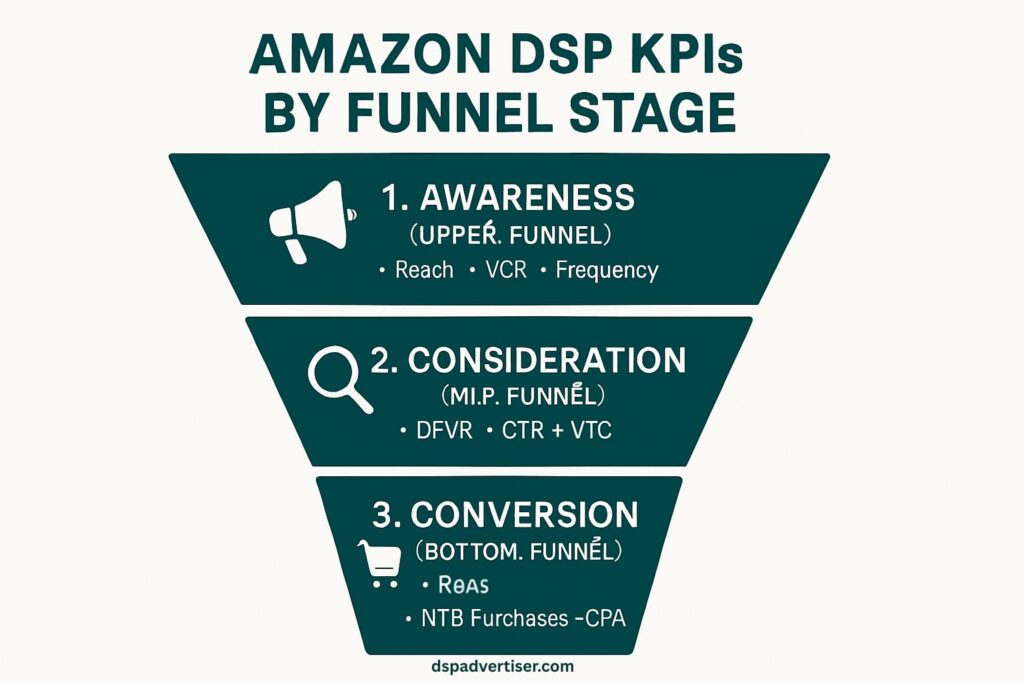
Awareness (Upper-Funnel KPIs for CTV Reach & Attention)
When you’re buying attention on CTV, it’s easy to get lost in clicks and impressions. But the truth? Upper-funnel metrics are about reach and attention—not sales. Think of it as lighting a spark rather than building a fire.
Metrics to Track:
- Impressions
- Reach
- Frequency
- Viewable Impressions
- CPM
- Video Completion Rate (VCR)
- Cross-Device Reach
- Brand Lift (Awareness & Consideration)
Why They Matter:
You’re paying for eyes on the screen. VCR and viewability show if people actually watched your ad. Frequency control prevents ad fatigue. Cross-device reach ensures your message hits viewers wherever they consume content.
Common Pain Points Solved:
Unmanaged frequency leads to wasted spend. Overlap between Sponsored Ads, DSP, and streaming placements often inflates CPM without boosting attention. Upper-funnel Amazon DSP metrics help stop these leaks.
Consideration (Mid-Funnel Amazon DSP KPIs)
This is where your audience starts warming up. It’s not about clicks alone—it’s about shopping intent. Think of it as guiding shoppers down the aisle before they pick a product.
Metrics to Track:
- Detail Page Views (DPV)
- Detail Page View Rate (DPVR)
- Click-Through Rate (CTR)
- Cost per Click (CPC)
- Engagement Rate
- View-Through Conversions (VTC)
Why They Matter:
DPVR is the clearest signal someone is interested in buying. CTR is helpful but not the main goal. VTC shows cross-device assist value. Mid-funnel Amazon DSP KPIs give your narrative measurability beyond “just awareness.”
Pain Points Solved:
CTV may drive views but not move the store. DPVR bridges that gap. Now your ad spend tells a story across devices rather than leaving guesses in your reporting.
Conversion (Bottom-Funnel KPIs to Prove ROAS & NTB Growth)
Here, it’s all about proving impact. This stage answers the question: Did DSP drive real growth? Think of it as turning a spark into a flame.
Metrics to Track:
- New-to-Brand Purchases (NTB)
- Return on Advertising Spend (ROAS)
- Cost per Action (CPA)
- Conversion Rate
- View-Through Conversions (VTC)
- Add-to-Cart influence (AMC)
Why They Matter:
NTB and ROAS show true DSP growth. VTC captures conversions across devices, especially for CTV-heavy paths. AMC ensures multi-device attribution clarity. Bottom-funnel Amazon DSP metrics prove your money worked—no guesswork.
Pain Points Solved:
You avoid budget cannibalization between Search Ads and DSP. Misattribution from CTV → mobile → Amazon app purchases gets clarified. Now, your spend drives measurable growth.
How to Read Amazon DSP Reports Without Getting Lost in Data
Reading DSP reports can feel like staring at a firehose. Numbers fly at you from every angle—impressions, CTRs, VCRs, DPVRs—and it’s easy to panic. But the trick is simple: start with the funnel. Without it, you’re trying to navigate a maze blindfolded.
Always Start with a Funnel KPI Map
Think of this as your roadmap. For awareness, track Reach, Viewable Impressions, and VCR. Mid-funnel? Focus on DPVR, CTR, and CPC. At the conversion stage, zero in on ROAS, NTB Purchases, and VTC. Mapping KPIs by funnel stage instantly tells you which metrics matter right now and which ones are supporting actors.
Frequency Guardrails
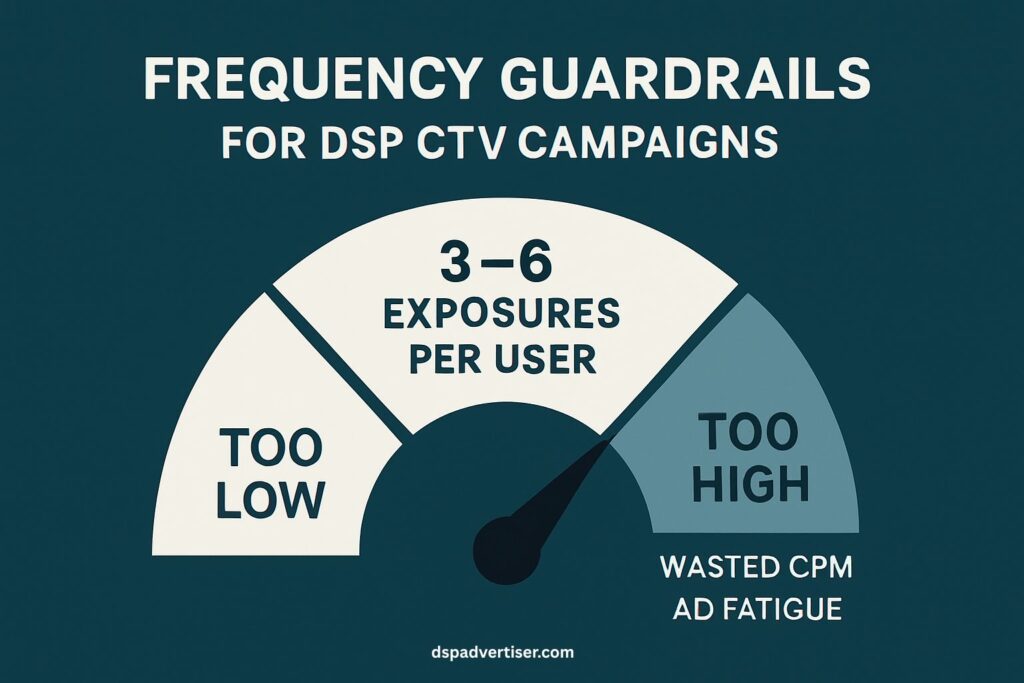
Frequency is like seasoning: too little and the ad doesn’t stick; too much and it turns bitter. For CTV DSP campaigns, aim for 3–6 exposures per audience. If you leave this uncapped or don’t watch it closely, and you risk viewer fatigue, wasted CPM, and a drop in engagement. Guardrails like this prevent budget leaks and keep your campaigns crisp.
Cross-Device Attribution Matters
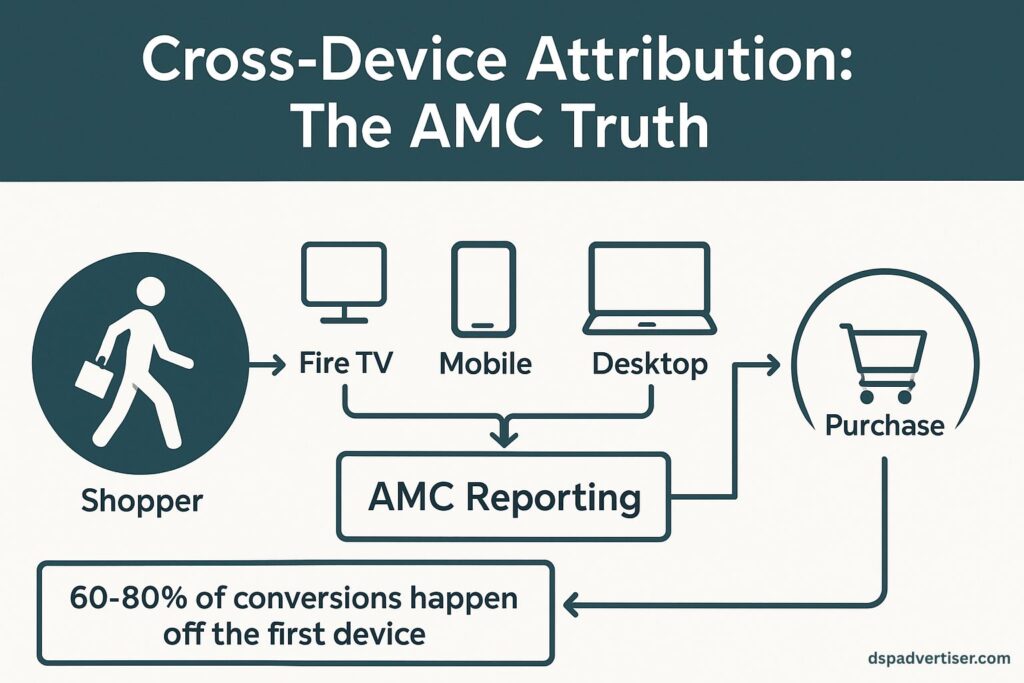
Here’s where most teams get tripped up. Shoppers hop devices constantly: they see your ad on Fire TV, browse on mobile, and purchase later on the Amazon app. 60–80% of conversions happen off the first device. That’s why AMC reporting is crucial. It connects the dots that DSP UI alone cannot, showing you the true impact of your campaigns across the entire shopping journey.
Real Story: How We Fixed CTV KPI Confusion for a Growth-Focused US Brand
A US brand came to us with a classic DSP problem: their VCR was sky-high, but nobody knew if it was moving real business. NTB purchases and DPVR were invisible in their reporting. On top of that, frequency had ballooned to 19+ exposures per viewer. Imagine paying to show the same ad nearly 20 times—like sprinkling sugar into your coffee until it’s bitter.
We stepped in and rebuilt their segmentation from scratch. We set funnel-based KPIs, aligned upper, mid, and lower-funnel metrics, and monitored cross-device reach carefully. Within 45 days, chaos turned into clarity: CPA dropped by 32%, and DPVR jumped 48%. The team finally saw that Amazon DSP KPIs, when read through a funnel lens, were not confusing—they were powerful growth signals.
This story proves one thing: DSP isn’t broken. Your reporting is. When the right Amazon DSP metrics by funnel are tracked, CTV becomes predictable, not a gamble.
What are the main Amazon DSP KPIs by funnel stage?
Upper-funnel KPIs focus on reach, impressions, VCR, and brand lift. Mid-funnel metrics track DPVR, CTR, and CPC. Lower-funnel KPIs prove growth through NTB purchases, ROAS, CPA, and VTC.
Why is DPVR more important than CTR?
DPVR reflects real shopping intent—people who actually explore product pages. CTR can be misleading in CTV or streaming environments where viewers rarely click. DPVR shows who is truly interested.
Should Amazon DSP be measured on clicks?
Only at mid-funnel. Upper-funnel campaigns should prioritize viewability, VCR, and reach. Lower-funnel campaigns rely on ROAS, NTB purchases, and VTC.
What is a good frequency range for DSP CTV advertising?
For most Amazon DSP CTV campaigns, a frequency range of 3–5 exposures per user is ideal on top of funnel. This level maximizes recall and attention without causing fatigue. Failing to monitor and control average frequency can lead to wasted CPM, over-frequency, and reduced reach efficiency — ultimately weakening campaign performance and attention metrics.