DSP Audience Types Explained: In-Market, Lifestyle, Contextual, Lookalike & Custom
Why Audience Targeting Makes or Breaks Amazon DSP Performance
Most brands feel the same pain when they start with Amazon DSP. The audience segmentation feels random, so the budget burns fast with no clear reason.
The goal of this guide is simple. I want to break down Amazon DSP audience types in a way that feels clear and easy to use. No jargon, no fluff—just what works in real campaigns. By the end, you will know which audience type to use and when to use it.
How Amazon DSP Audiences Work
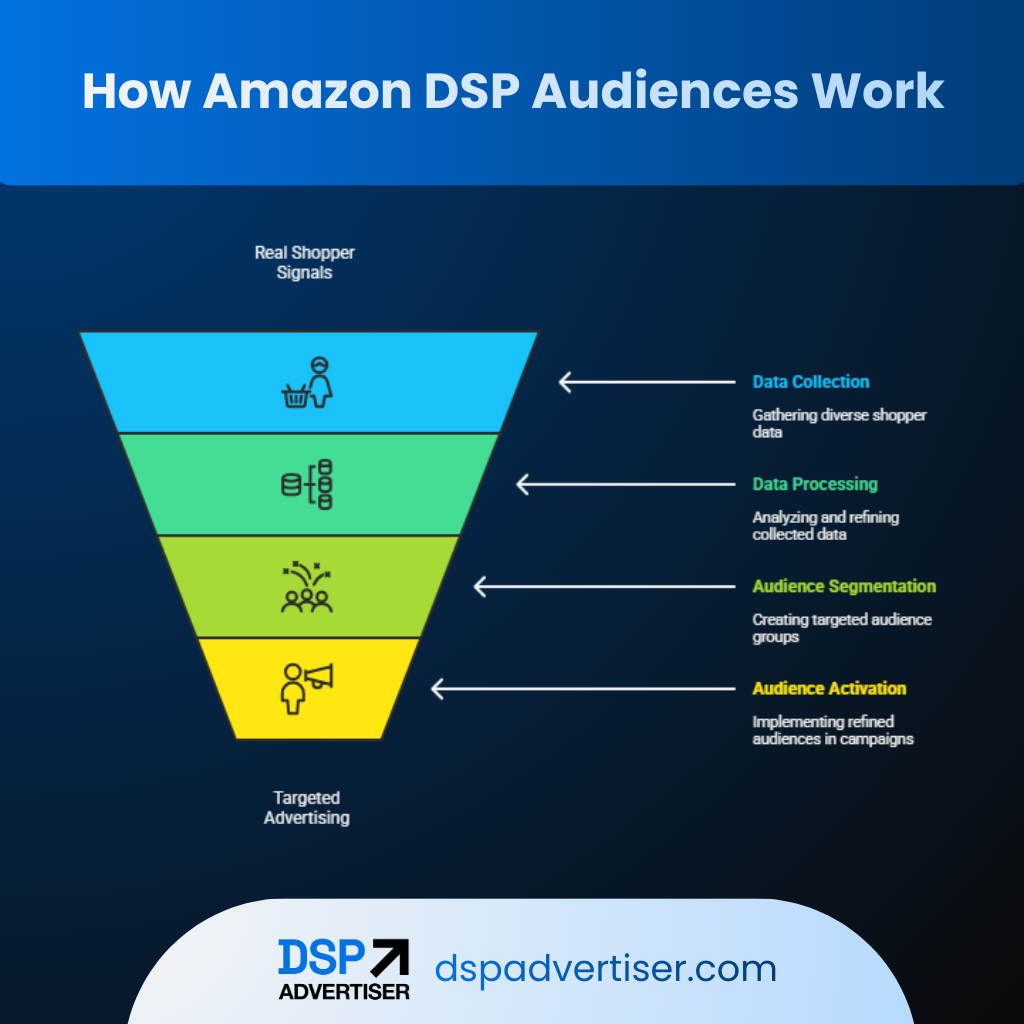
Amazon DSP can feel complex at first, but the core idea is simple. Amazon watches real shopping signals as they happen. These signals show what people search, browse, and buy across millions of products. When you use them the right way, your Amazon audience segmentation becomes much sharper and easier to control.
Most programmatic tools guess who a shopper might be. Amazon DSP does not guess. It reads real actions from real shoppers. That is why Amazon DSP audience types feel so accurate when you activate them.
Amazon First-Party Data Advantage
Amazon first-party data sits at the heart of how Amazon DSP audiences work. The system reads shopping signals, browsing signals, and purchase intent data in real time. These signals show what users want, not what they might want. It is like watching a shopper walk down an aisle instead of reading an old survey.
Amazon also connects users with household-level identity and cross-device matching. A person can browse on mobile, watch Fire TV, and buy on desktop—and Amazon links all of it. This device graph makes the targeting far more stable. You stop wasting money on the same user across different screens.
This is what makes Amazon DSP so different from other programmatic platforms. Most tools rely on third-party data that fades fast. Amazon uses fresh, live data pulled from real shopping behavior.
Real-Time & Dynamic Audience Updates
Amazon DSP audience types update all the time. Lookback windows help you reach people who showed interest within a set number of days. Recency targeting lets you reach shoppers who acted in the last few hours or days. This keeps your targeting sharp and avoids stale users.
Predictive refinements also shape the audience. Amazon uses machine learning to spot patterns before buyers convert. It feels like seeing the turn before the road bends. This helps you reach shoppers right before they take action.
Where Amazon DSP Audiences Come From
Amazon pulls audiences from several sources. The main one is the Amazon Advertising system that tracks real shopper behavior. This includes search queries, product views, and purchase data. These signals help build strong Amazon shopping signal audiences.
Another big source is AMC, also known as Amazon Marketing Cloud. AMC lets you build deeper insights and model custom journeys. You can create audiences based on steps a shopper takes across ads, pages, and devices. It feels like drawing the full map instead of looking at one stop.
You can also track actions with the Amazon Ad Tag, often called the pixel. This helps create pixel-based audiences and event-based audiences from your own site. Off-Amazon signals also feed into the DSP when you upload customer data or use remarketing flows.
All these inputs come together to build Amazon audience types that feel clean and strong. You get real actions, real timelines, and real identity signals. This is what makes the system so powerful.
Amazon DSP Audience Types (Full Breakdown)
1. In-Market Audiences (High Intent)
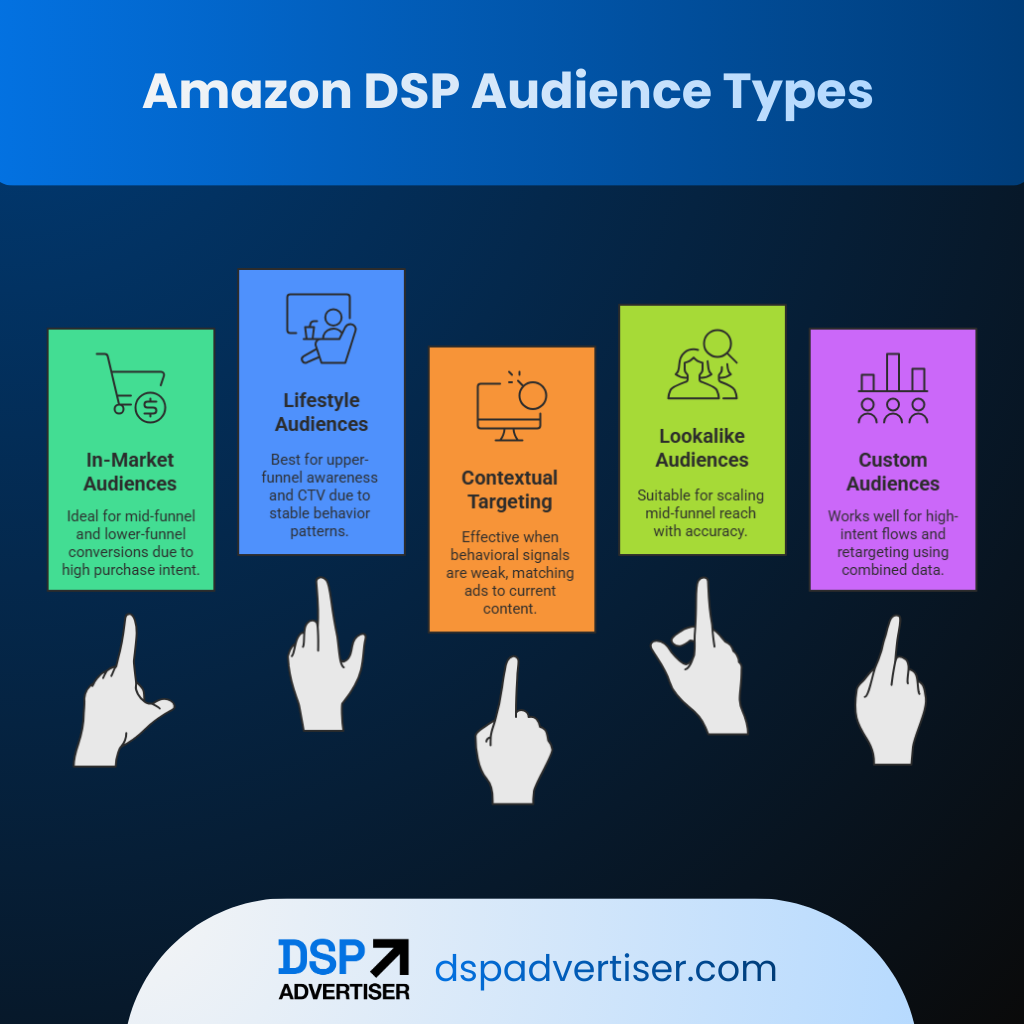
Amazon in-market audiences reach people already searching, browsing, and comparing products in your category. These users show real Amazon shopping signals and purchase intent data, so they are ideal for mid-funnel and lower-funnel conversions. The groups stay fresh with recency targeting and audience lookback windows. When I switched a cookware brand to in-market audiences, the CPA dropped fast without changing bids.
2. Lifestyle Audiences (Long-Term Behavior)
Amazon lifestyle audiences follow long-term habits and affinity patterns based on browsing signals and purchase behavior. They scale well for upper-funnel awareness and CTV because the behavior stays stable over time. These audiences help widen reach without wasting budget. A wellness client saw stronger CTV reach and lower CPMs when we used lifestyle audiences tied to health-focused shoppers.
3. Amazon Contextual Targeting (Content-Based Signals)
Amazon contextual targeting matches ads to real browsing and content consumption across Amazon Publisher Services, Fire TV, and Freevee. It works well when behavioral or in-market signals are weak. You reach users based on what they watch, read, or explore right now. I used contextual layers on Fire TV home-improvement shows to drive awareness when search demand was low.
4. Amazon Lookalike Audiences (Modeled Expansion)
Amazon lookalike audiences use seed audiences, AMC signals, the device graph, and household-level identity to find new users with similar buying signals. They are ideal for scaling mid-funnel reach with high quality. These modeled groups help you grow without losing accuracy. A new brand with no DSP history scaled quickly when we built lookalikes from early pixel-based audiences.
5. Amazon Custom Audiences (Your Data + Amazon Data)
Amazon custom audiences combine your own data with Amazon DSP first-party data. You can build pixel-based audiences, event-based audiences, remarketing audiences, demographic targeting groups, behavioral targeting segments, and brand affinity audiences. These audiences work best for high-intent flows, retargeting, and lower-funnel conversion paths. One strong setup is a CTV → retarget → purchase loop using off-Amazon audience activation.
Bonus Audience Categories Buyers Often Overlook
Streaming TV Audiences
Streaming TV audiences come from Fire TV, Freevee, and Twitch signals. These viewers behave differently because they are relaxed, focused, and watching on the biggest screen in the home. Amazon DSP uses household-level targeting and the device graph to connect these moments back to real Amazon shopping signals. I once ran a CTV test on Fire TV, and the brand saw a spike in new-to-brand lift faster than expected.
Predictive Audiences
Predictive audiences use machine-learning models to forecast upcoming intent before a shopper takes action. They update through dynamic audience updates and recency targeting, so the signals stay sharp. These groups help you reach users who are close to buying but have not shown strong behavior yet. I used predictive layers for a home-goods brand, and the mid-funnel audience segmentation finally felt stable.
Demographic & Household Audiences
Demographic audiences include household income, presence of children, and device ownership. These groups add simple but useful layers to Amazon DSP audience types. They work best when paired with in-market audiences or lifestyle audiences for deeper context. I often use them to filter out low-relevance homes and keep the reach clean.
Amazon Audience Segmentation Strategy: What Actually Works Today
Upper-Funnel (Awareness)
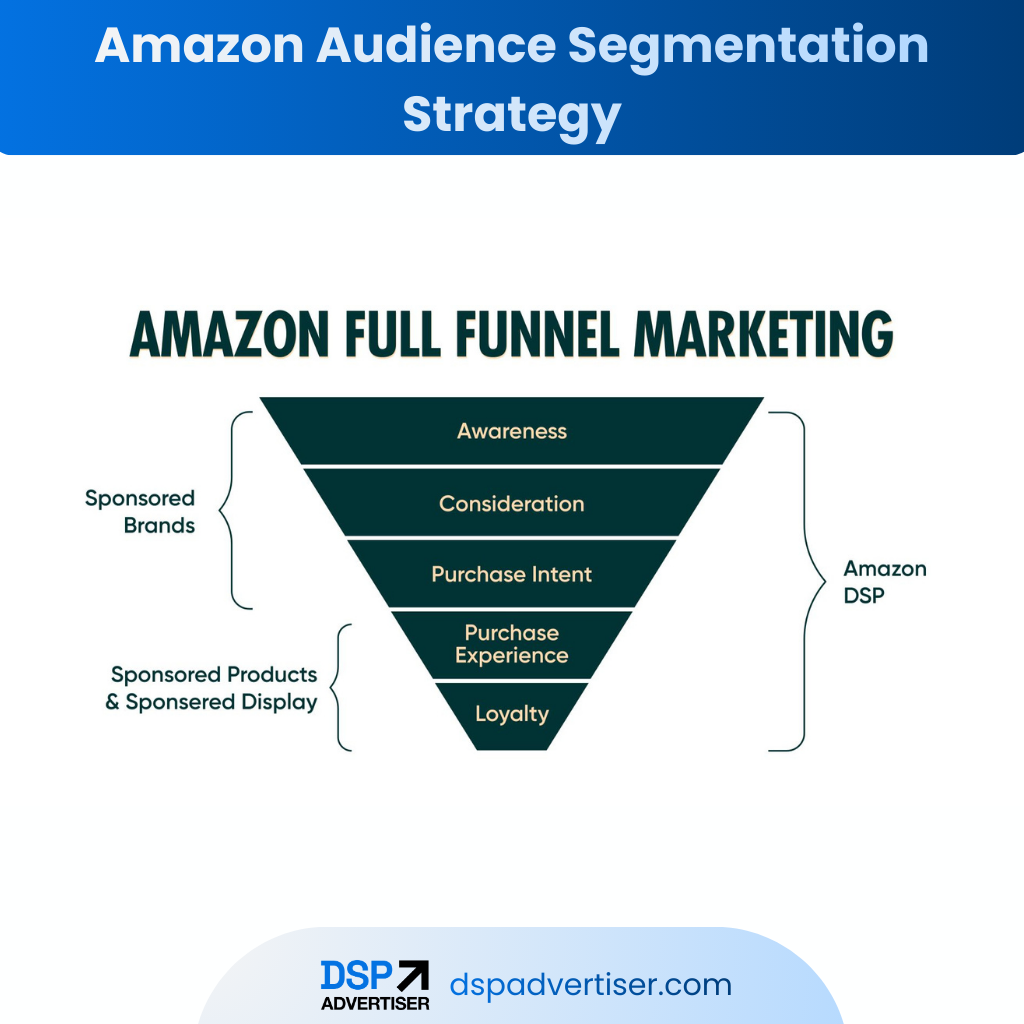
For awareness, lifestyle audiences, contextual targeting, and predictive audiences work best. These groups scale well across CTV and streaming placements. They match real browsing signals and interest-based targeting without needing strong purchase intent data. I use them when brands want reach without wasting budget.
Mid-Funnel (Consideration)
Lookalike audiences and in-market audiences make the perfect mid-funnel mix. Lookalikes expand reach, while in-market audiences keep the intent strong. Exclusions stop overlapping audiences and keep the campaigns clean. AMC audience insights help you see where people move and where the waste happens.
Lower-Funnel (Conversion)
Custom audiences, remarketing audiences, and pixel-based audiences drive the final step. These audiences catch shoppers who already showed firm intent across Amazon shopping signals or your own site. They work well for lower-funnel conversion flows and CTV retargeting loops. A simple setup like CTV → retarget → purchase still wins for most brands.
Avoiding Overlapping Audiences & Wasted Budget
Avoiding overlapping audiences protects your spend and boosts accuracy. You can use exclusion rules, frequency capping, and clean audience suppression. AMC audience insights help you find crossover and remove it fast. When you keep deduplicated reach clean, the whole plan performs better.
Measurement, Reporting & AMC Insights
How AMC Helps You Read Audience Quality
AMC shows how your Amazon DSP audiences act. It lets you see where groups mix. It shows new-to-brand lift. It also shows each step in the path to buy. These AMC insights make it easy to see which Amazon shopping signal groups move and which ones stop. Household identity data shows where real buyers come from, not guesses.
Why Most Agencies Fail at Amazon DSP Audiences
Most agencies fail because their segmentation is weak and their setups ignore the device graph. They skip audience suppression, so overlapping audiences eat the budget. They also never use AMC-only audiences, which means they miss the best signals. I fixed a client’s account by cleaning these gaps, and their mid-funnel audiences came alive in a week.
Real Examples: What I Learned Running Amazon DSP Audiences Across CTV & Streaming
I learned a lot from using Amazon DSP on Fire TV, Twitch, and Freevee. What worked was clear. Use clean Amazon audience groups. Use strong block rules. What did not work was a mix of too many audience types. There was no time rule and no live updates. The big lesson was this: the right audience type can change ROAS fast. It hits even harder when Fire TV meets in-market groups.
One case stands out for me. A brand used CTV on Fire TV with Amazon in-market audiences tied to their category. The CPMs stayed stable, and the new-to-brand lift doubled because the signals were fresh. It showed me how Amazon first-party data and real purchase intent data change the game.
The Smart Way to Use Amazon DSP Audience Types
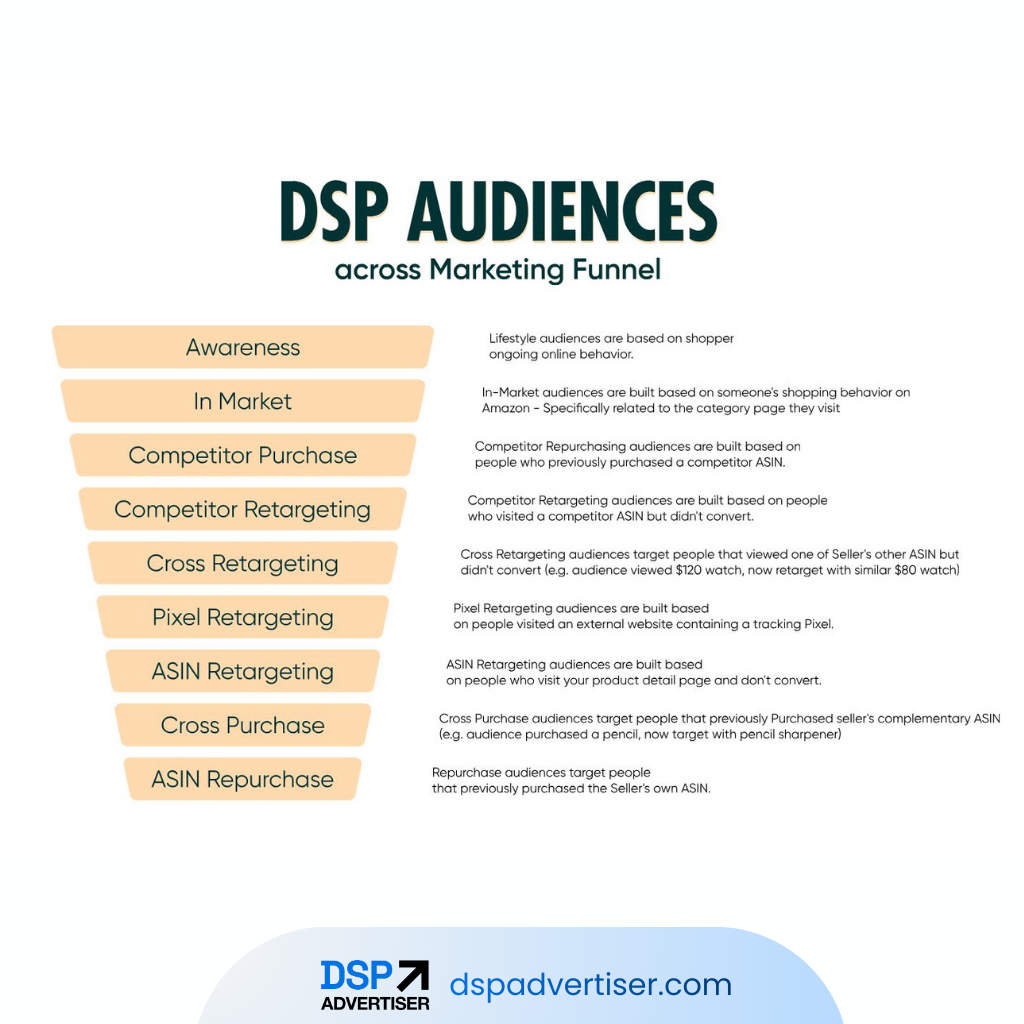
Amazon DSP works best when your audience plan is simple and clean. In-market groups bring strong intent. Lifestyle groups help you grow reach. Context groups add live signals. Lookalike groups help you scale. Custom groups help you win. Stream groups and smart pick groups fill gaps when the funnel needs help.
Quick Comparison Table
| Audience Type | What It Means | Best Use Case |
| In-Market | Shoppers with high buying intent and active search signals | Strong conversions, lower-funnel wins |
| Lifestyle | Long-term interest patterns mapped by Amazon | CTV campaigns, audience building |
| Contextual | Targeting based on current content being viewed | Awareness, top-of-funnel reach |
| Lookalike | Modeled audience built from seed data | Scalable reach with similar behaviors |
| Custom | Your data + Amazon audience matching | Retargeting and nurturing |
| Streaming | Fire TV, Freevee, Twitch viewers | Large-screen impact + premium attention |
| Predictive | AI models to forecast future shopping intent | Early-stage conversion capture |
What are the main Amazon DSP audience types?
The core audience types are in-market, lifestyle, contextual, lookalike, custom, streaming, and predictive. Each supports a different stage of the funnel from awareness to conversions.
What are Amazon in-market audiences?
They target shoppers with active purchase intent based on recent Amazon searches, cart actions, and browsing behavior—ideal for high-conversion campaigns.
Are Amazon lifestyle audiences good for CTV?
Yes. Lifestyle segments are built on long-term habits, making them stable and highly effective for Fire TV, Prime Video, and broader CTV exposure.
How do Amazon lookalike audiences work?
They expand reach by finding people similar to your best customers using seed data, AMC identity signals, and the device graph.
What is Amazon contextual targeting?
It targets users based on content they currently watch or browse across Fire TV, Freevee, IMDb, Twitch, and Amazon Publisher Services—great for awareness.
What are Amazon custom audiences?
They combine your data with Amazon’s first-party identity graph to build retargeting and re-engagement segments from CRM lists, pixels, and app events.
How can I avoid overlapping Amazon DSP audiences?
Use audience suppression, exclusions, and AMC overlap reports to keep frequency clean and reduce wasted impressions.
How does AMC improve DSP audience strategy?
AMC reveals cross-device paths, household identity, frequency impact, and new-to-brand lift—helping refine targeting and budget allocation.