What Brands Really Want From Connected TV Advertising Today
The Connected TV (CTV) world feels noisy right now. Everyone talks about reach, attention, and big screens, yet the results often tell a different story. Many brands feel confused because Prime Video and YouTube results don’t match their expectations.
Most growth teams share the same pain. They deal with inconsistent CTV performance and do not know which metrics to trust. Reports show gaps, platforms overlap, and budgets get hit with wasted frequency. I hear this most when brands run YouTube and Amazon CTV ads at the same time with no control over frequency. It is hard to act when you cannot see the full picture. It feels like trying to steer a car at night with the headlights off.
I get it because I’ve lived it. I work with performance-driven brands, and I’ve tested both YouTube and Prime Video across many CTV setups. I’ve watched CPM shifts, attention swings, and real reach differences between platforms. I’ve seen how YouTube vs Amazon Prime Video ads behave when budgets scale fast. And I’ve seen how simple fixes can save brands from a lot of waste.
That is why I want to break this down in a clear and calm way. No jargon. No hype. Just what matters for brand awareness on real CTV platforms today. My goal is to compare Prime Video vs YouTube through a practical lens that puts reach, attention, and outcomes first. If you have ever wondered where your CTV dollars should go, this guide will help you see the path forward with confidence.
YouTube vs Amazon Prime Video Ads — What Makes Them Different?
Platform Purpose & Viewer Mindset
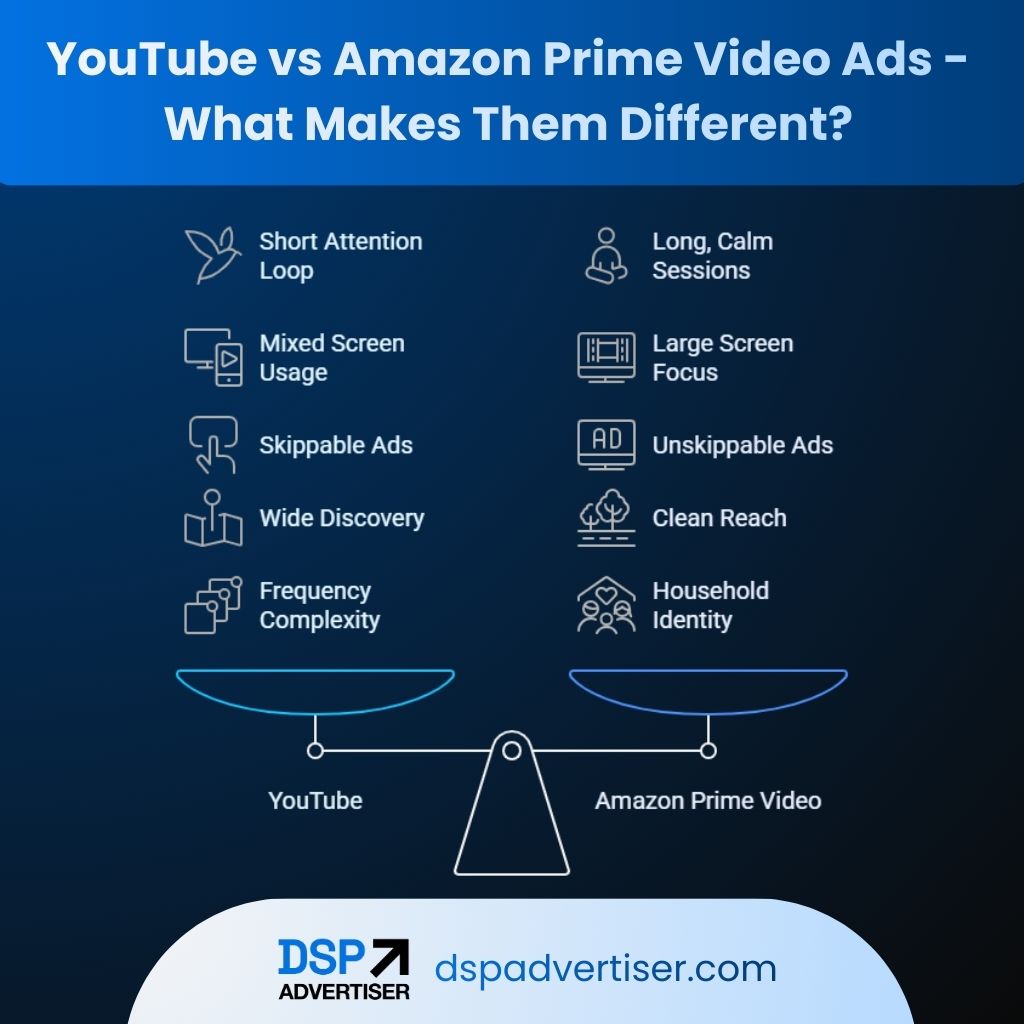
YouTube and Prime Video may both sit under the CTV umbrella, but they serve very different roles. YouTube is a creator-driven space where people jump between videos with a clear intent and a short attention loop. Prime Video is the opposite: it is a premium ad-supported streaming space built for long, calm sessions on large screens. When you compare Prime Video vs YouTube advertising, this difference in mindset becomes the biggest driver of brand awareness.
I see this difference every time I run both channels in the same media mix. YouTube advertising works well when users search, explore, or follow creators they trust. Prime Video works when people lean back on the couch and stay present on the big screen. One feels like a busy street, the other feels like a quiet living room.
Viewer presence is a major factor in the attention economy. People may watch YouTube on phones, tablets, desktops, or TV, and that mix changes how they take in ads. Prime Video ads land mostly on large screens with viewers in a relaxed state, and that boosts attention and video completion rate without extra effort. When I see higher engagement on Amazon Prime Video ads, it is usually because the environment encourages focus by default.
This shift in mindset explains why YouTube attention metrics vs Amazon often look different even with the same creative. A skippable YouTube ad fights for a moment in a crowded feed. A Prime Video ad has the full screen, no scroll, and predictable viewer presence. The screens may look similar, but the context is not the same.
Ad-Supported Reach & Composition
Prime Video’s ad tier has grown fast, and that expansion has changed how brands think about Amazon streaming TV ads. More viewers now watch premium shows with built-in ad breaks, which opens the door for clean reach on quality content. This growth gives brands new room to scale without fighting the noise of creator content. When I run campaigns here, I see more stable delivery and cleaner CPM patterns.
YouTube CTV usage has also exploded, especially on living room devices. Many households use YouTube as their “second TV,” and that boosts reach for YouTube brand awareness ads across all screens. It is great for wide discovery, and it scales fast when budgets grow. The mix of screens helps reach people anywhere, but it also adds complexity when you try to control frequency.
This is where deduplicated reach becomes a big deal. Many brands do not realize how much overlap happens when YouTube and Amazon Prime Video ads run side by side. The same viewer may see both campaigns many times without any control. When I look at reports, this overlap is often the hidden cause of wasted budget.
Running both platforms is still smart, but you need a plan. Upgrading Amazon DSP controls helps with cross-device frequency capping. YouTube gives broad reach, but Amazon gives cleaner household-level identity resolution. When you combine them with a clear strategy, you get stronger brand awareness CTV platforms without heavy waste.
Comparing CPMs: Prime Video CPM vs YouTube CPM
When brands compare Prime Video vs YouTube advertising, CPM is often the first thing they look at. Most teams expect one clear winner, but the truth is more nuanced. YouTube CPMs tend to fall in a lower range because the supply is huge and the formats are flexible. Prime Video CPMs often sit higher because the ads land in a premium place with viewers who stay present on the big screen.
These typical CPM ranges are broad by design, since each brand sees different costs based on targeting and setup. YouTube often sits in a lower band with skippable ads, and non-skippable formats push the cost up. Masthead ads can spike the CPM far above normal because they grab so much instant reach. Prime Video CPM ranges start higher but stay steady, and that stability helps when planning a brand-awareness budget.
Prime Video CPMs skew higher for a reason that becomes clear when you see the ads live. The viewer sits back and watches on a large screen with full focus. The room is calm, and the ad takes over the whole space without scroll or skip. That presence boosts attention in a way that raw CPM cannot explain.
YouTube CPMs move around because the ad formats behave so differently. A skippable ad may be cheap, but you fight the skip button every second. A non-skippable ad costs more, but it opens space for message recall. The mix gives brands control, but it also means you need a clear goal before picking a format.
I have seen many teams waste money on CPM because they target too wide or hit the same people too often. This happens most when brands use both YouTube advertising and Amazon streaming TV ads at the same time. We reduce this waste by leaning on strong first-party data and firm frequency controls. When you set limits and feed better signals, each platform stops trying to win the same viewer over and over again.
Brand Awareness Performance: Attention, Engagement & Lift
Attention Metrics — YouTube vs Amazon
When you compare YouTube attention metrics vs Amazon, you notice the difference in viewer behavior right away. YouTube tracks viewable impressions, attention scores, and skip rates, and these tell a story of constant movement. Viewers jump fast, and the creative must earn a moment of focus. The good news is that YouTube gives you a river of signals, so you can see what works in real time.
Amazon takes a simpler and stronger path. Prime Video ads run in a place where people sit back and stay with the story. The screen is big, the environment is calm, and the viewer stays put. This setup lifts attention without needing tricks or tight creative hooks.
The gap in video completion rate often surprises brands. YouTube completion rates shift with screen size, ad type, and creative style. Prime Video completion rates rise because people watch full episodes and expect breaks to appear. When I see high completion on Amazon, it often means the viewer stayed relaxed and open to the message.
These attention patterns match what I see in real campaigns. YouTube is great for quick hits and broad reach, but you must work hard to hold the viewer. Prime Video wins on presence, and that presence lifts awareness even when CPMs run higher. Both matter, but they matter in different ways.
Ad Lift & Brand-Safety Signals
YouTube sits on a huge creator ecosystem that gives brands endless reach. This is great for scale, but it means you must watch brand safety with care. Even with strong controls, mixed creator content brings surprises. The good news is that YouTube tools have improved, and most issues are avoidable with a clear setup.
Prime Video makes brand safety simple. The supply is professional, predictable, and built for streaming. You know where your Amazon Prime Video ads will land, and you know the content will fit a safe space. This peace of mind helps when building long-term brand trust.
Amazon also has a strong edge in identity resolution. When ads run through the Amazon DSP, the system links screens and households with more accuracy. This link boosts brand-lift measurement because you see who watched and who responded. The result is cleaner insight and better planning for the next round.
I have seen this play out many times. YouTube brings more variety and discovery, but Amazon brings stability and clarity. When a brand needs strong lift signals, Amazon often shows the way. When a brand wants fast reach, YouTube takes the lead.
Targeting & Data Accuracy: Amazon First-Party vs Google Signals
Targeting is where the difference between Prime Video vs YouTube advertising becomes very clear. Both give strong reach, but the way they read the viewer is not the same. I tell brands to think of it like two maps: Google shows the roads people travel online, while Amazon shows what they buy once they get there. When you blend these signals with clean frequency capping, your brand-awareness CTV platforms get much stronger.
YouTube Targeting Strengths
YouTube holds a huge edge in keyword and contextual targeting. People search, click, and explore, and each action leaves a trail of intent. YouTube advertising uses this trail to find viewers who match a moment, a mood, or a topic. This makes YouTube brand awareness ads great for fast reach around active interests.
Google audiences add another layer of power. Search and Video cross-pollination helps the system predict who is in the market for a product. I have seen this work well for brands with fast sales cycles or niche segments. When a viewer searches for a need and then sees a YouTube ad, the lift can show up fast.
The best part is how easy it feels. You pick your keywords, set your segments, and YouTube starts to learn. It is simple, and it scales without much stress when the goal is broad reach.
Prime Video Targeting Strengths
Amazon goes deeper, and this depth changes everything. Amazon Prime Video ads tap into real shopping and stream-to-buy data. This is not guesswork. It is the actual path people take when they shop, browse, and buy. When a viewer has clear buying patterns, Amazon knows it, and the ad delivery adjusts in real time.
Household-level identity is a big win here. Prime Video ads run inside a home, and the Amazon DSP reads the whole household as one unit. This boosts accuracy and cuts waste. You reach the right home with the right message, instead of chasing the same device across the web.
Cross-device reach is stronger too. When the campaign runs through Amazon DSP, the system tracks exposure across TV, mobile, and desktop without losing track of the viewer. This gives more control and cleaner frequency capping. I have seen this stop runaway impressions on CTV and bring CPM waste down fast.
It feels like switching from a wide net to a guided spotlight. The reach stays strong, but the waste drops, and the impact rises.
Measurement & Attribution
Measurement is where the two worlds split again. YouTube has solid GA and GMP integration, and this helps brands trace the early steps of discovery. You get strong insights around viewable impressions, engagement, and lift. The data is easy to read and fits into most reporting stacks without stress.
Amazon delivers more depth, but the system can feel complex if it is not managed. AMC, DSP, and Seller Central all hold different pieces of the truth. When these parts work together, the reporting is rich and clear. You see who watched, who shopped, who added to cart, and who moved closer to buying.
But when brands run these systems alone, the data can feel like scattered puzzle pieces. I see this a lot when teams try to track Amazon streaming TV ads, Sponsored Ads, and DSP at the same time. Once the data is unified, the whole picture changes. You start to see the real lift behind Prime Video vs YouTube advertising, and you can plan with confidence.
Reach Comparison: Prime Video vs YouTube
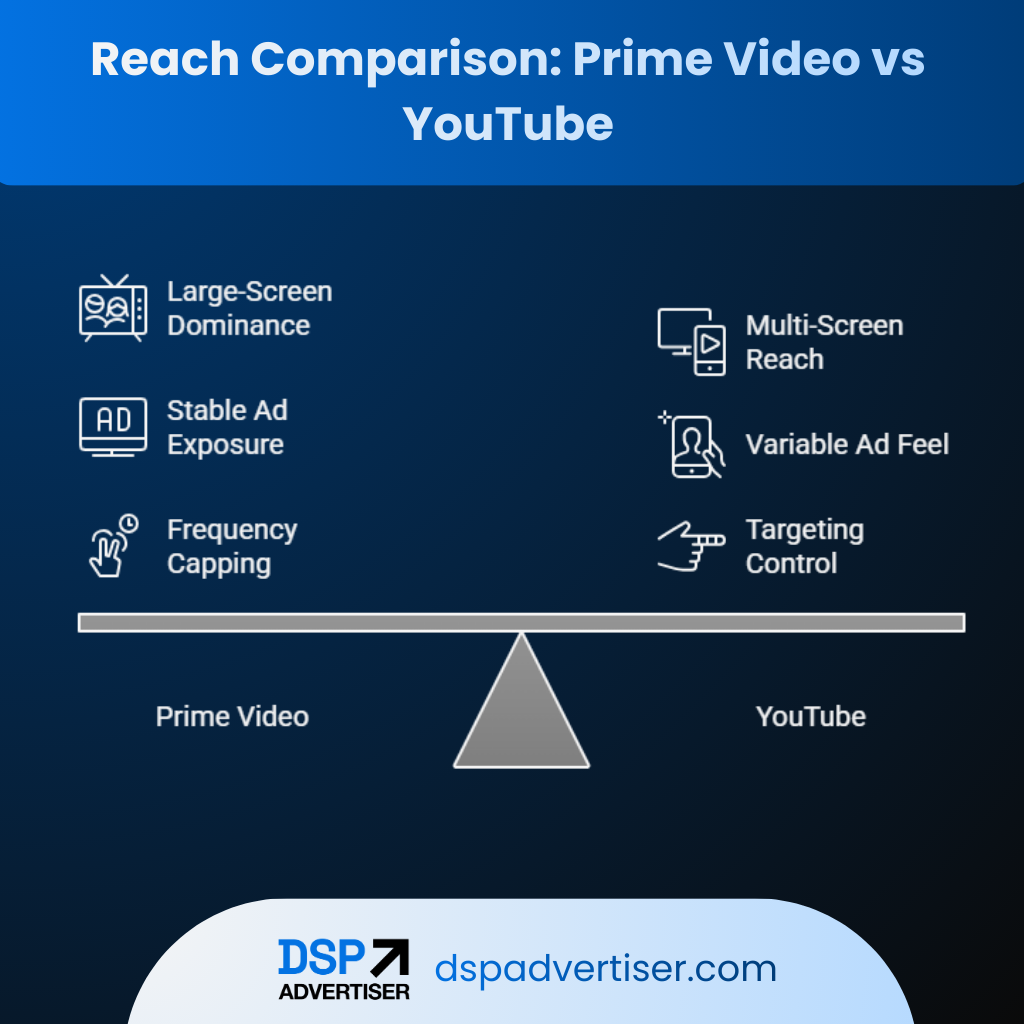
Reach is the most common question brands ask me about, and it is also the easiest place to make mistakes. Both platforms scale, but they scale in different ways. YouTube casts a wide net across many screens, while Prime Video holds tight to the large-screen space. The reach comparison between Prime Video vs YouTube becomes more clear when you watch how each one behaves in a home.
Large-Screen Dominance
Prime Video is almost fully large-screen. People sit down, relax, and watch long stories. This gives brands stable reach and predictable ad exposure. The viewer is not scrolling or tapping.
They are in the room, and the ad owns the screen. YouTube splits its reach across screens. Some viewers watch on TV, some on mobile, and some on desktop. This mix is great for scale, but it changes the feel of the impression.
A YouTube CTV ad on a TV looks strong. A YouTube skippable ad on a phone feels very different. This blend matters when you want a clear brand-awareness signal. I think of it like this: Prime Video is the big theater, and YouTube is the whole city.
Deduplicated Reach & Avoiding Overlaps
The real issue is overlap. Most brands do not notice how often they hit the same viewer on both platforms. YouTube CTV can stack impressions fast, and Prime Video can do the same when budgets grow. Without controls, the viewer ends up seeing far more ads than the plan intended.
I once saw a brand hit a single household more than 40 times in one week because both platforms were pushing hard with no shared cap. The brand thought it was expanding reach, but it was burning budget on the same home over and over.
Amazon DSP helps here. It caps frequency across Prime Video, Fire TV apps, IMDB, Twitch, and other streaming supply. This cuts waste and spreads impressions out in a cleaner way. When we pair this with first-party data and smart pacing, the overlap drops and the total reach grows.
YouTube helps too, but the control depends on how wide you target and which formats you use. When both systems work together with one plan, the reach gets cleaner and more balanced. It feels less like shouting to the same room and more like speaking to new people each day.
Which Platform Is Better for Brand Awareness? (My Honest Assessment)
This is the question brands ask me most, and the answer is simple: it depends on what you want. Prime Video vs YouTube advertising is not a battle. It is a choice between two strengths.
YouTube wins when you need low CPM, fast scale, and flexible ad formats. The system can reach the top of the funnel fast with skippable, non-skippable, bumper, and masthead options. It is great for discovery and wide awareness.
Prime Video wins when you need premium CTV presence, high attention, and measurable brand lift. The large-screen viewing and calm environment create strong impact for brand stories. You see the lift in recall, intent, and even shopping behavior.
But the truth is that a blended strategy usually performs best. One brand I worked with wasted nearly 35% of its CTV budget by running YouTube and Amazon streaming TV ads with no shared plan. Once we fixed the frequency overlap and cleaned the targeting, the reach almost doubled without raising the budget. It felt like turning the lights on after months of guessing. Both platforms shine. They just shine in different rooms.
-
Is Prime Video advertising better than YouTube for brand awareness?
Both platforms perform well, but in different ways. Prime Video drives stronger attention on living-room screens, while YouTube delivers broader reach and faster audience scaling, especially across South Asia and GCC markets.
-
What’s the typical CPM for Prime Video ads?
Prime Video CPMs are generally higher than YouTube because ads run in premium, ad-safe, long-form streaming environments.The cost is higher, but you gain longer viewing sessions, higher completion, and stronger brand recall.
-
Is YouTube good for CTV brand advertising?
Yes, especially for wide awareness campaigns. YouTube now acts like a full CTV broadcaster, offering mass reach, smart targeting, and large-screen delivery across mobile, TV apps, and Smart TVs in Bangladesh, India, UAE, KSA, and Qatar.
-
Which platform has better attention metrics—Prime Video or YouTube?
Prime Video typically leads in attention. Its lean-back, non-scroll environment reduces distraction and boosts watch time, ad completion, and message retention more consistently than YouTube.
-
Should I run both YouTube and Amazon Prime Video ads together?
Yes, most growth-focused brands blend both. Running them together improves reach diversity, frequency balance, and cross-screen exposure, while preventing reliance on a single CTV network.
-
How do I avoid frequency waste across CTV platforms?
Use one unified DSP with shared IDs and strict frequency controls. This ensures household-level capping, stops repetitive impressions on CTV apps, and maintains clean delivery without viewer fatigue.